
Stair Nosing Cost NZ: Budget Your Stairs Right the First Time
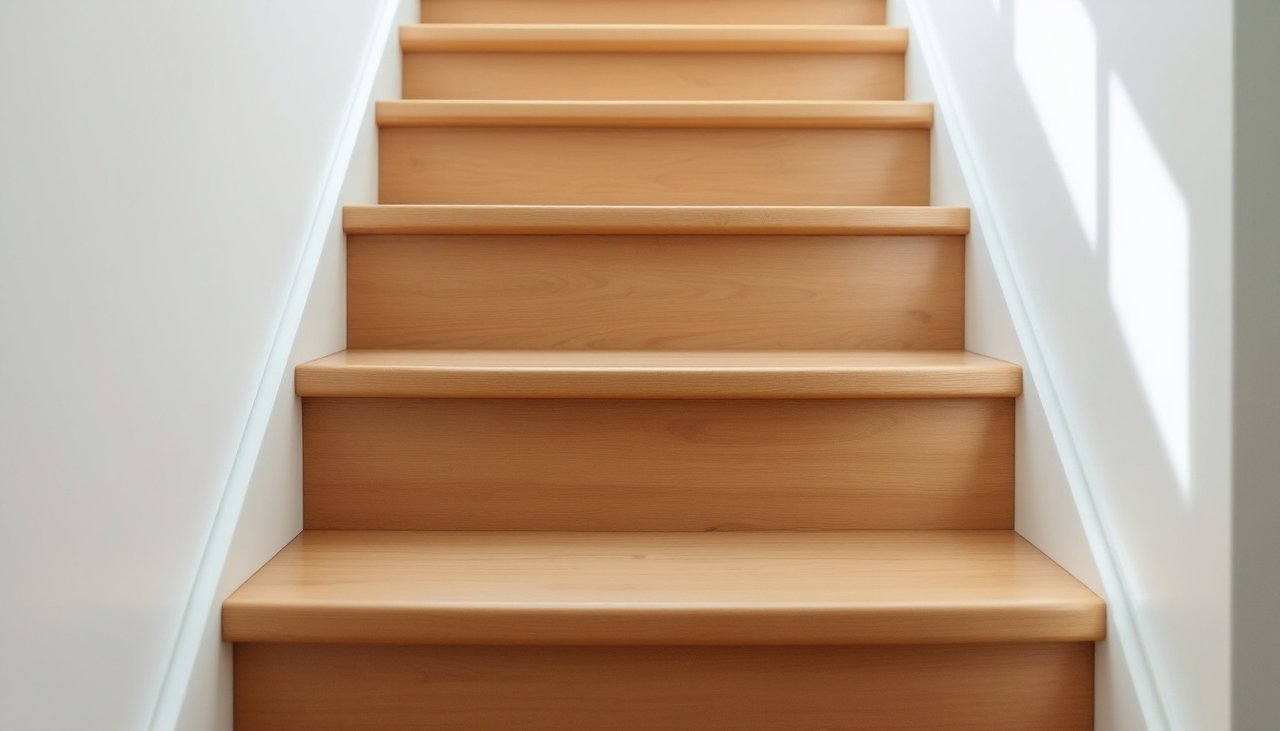
The nosing is rarely the expensive part of a staircase. On a typical 13 step stair, the aluminium profiles from a New Zealand hardware store can come in under $300. Yet the stair is often the line on a flooring quote that blows the budget. You are paying for cutting, fixing and edge preparation on every tread, and the price per metre on the shelf hides how much offcut you will buy.
Get the stair priced properly before you commit to a floor. Send us your stair measurements and floor choice and we will itemise the nosing, tread and labour lines for you, so you can compare quotes on the same scope.
What Stair Nosing Costs in NZ Right Now
Here is what common stair nosing profiles cost at New Zealand retailers, checked online on 9 October 2026. These are shelf prices for the profile only. They are not Power Dekor prices and not installed quotes, and retail prices change often.
| Profile (as listed) | Retailer | Length | Price | Price per metre |
|---|---|---|---|---|
| Metal Mate aluminium section stair nosing, 43.2 x 23 mm | Mitre 10 | 1.0 m | $22.80 | $22.80 |
| Rapid black aluminium stair nosing, 43.2 x 23 x 1.5 mm | Bunnings | 2.0 m | $42.73 | $21.37 |
| Roberts 8 mm stair nosing trim, silver | Bunnings | 3.3 m | $49.83 | $15.10 |
| Aluminium stair nosing, solid carborundum anti slip insert | Slip Proof NZ | 3.0 m | $96.00 | $32.00 |
On paper the spread is roughly $15 to $32 per lineal metre. Most people budget from that number, and it is the wrong one. Profiles are sold in fixed lengths, each tread needs one unbroken piece, and a joint in the middle of a stair edge is a trip and failure point. What you actually pay depends on how many full tread pieces you can cut from each length.
The table also ignores fit. A profile is designed around a floor thickness and fixing method, so the cheapest one per metre is no saving if it does not suit your floor.
- Retail aluminium nosing in NZ currently sits around $15 to $32 per metre before cutting and fixing.
- Per metre pricing ignores the fixed lengths profiles are sold in.
- A profile has to match your floor thickness, or it is not a saving at all.
Price Per Metre vs Price Per Staircase
To see why the shelf price misleads, run the same staircase through each length. Assume 13 treads. The first column uses 900 mm wide treads, a common width for a domestic stair. The second uses 1,100 mm treads, closer to a wider feature stair.
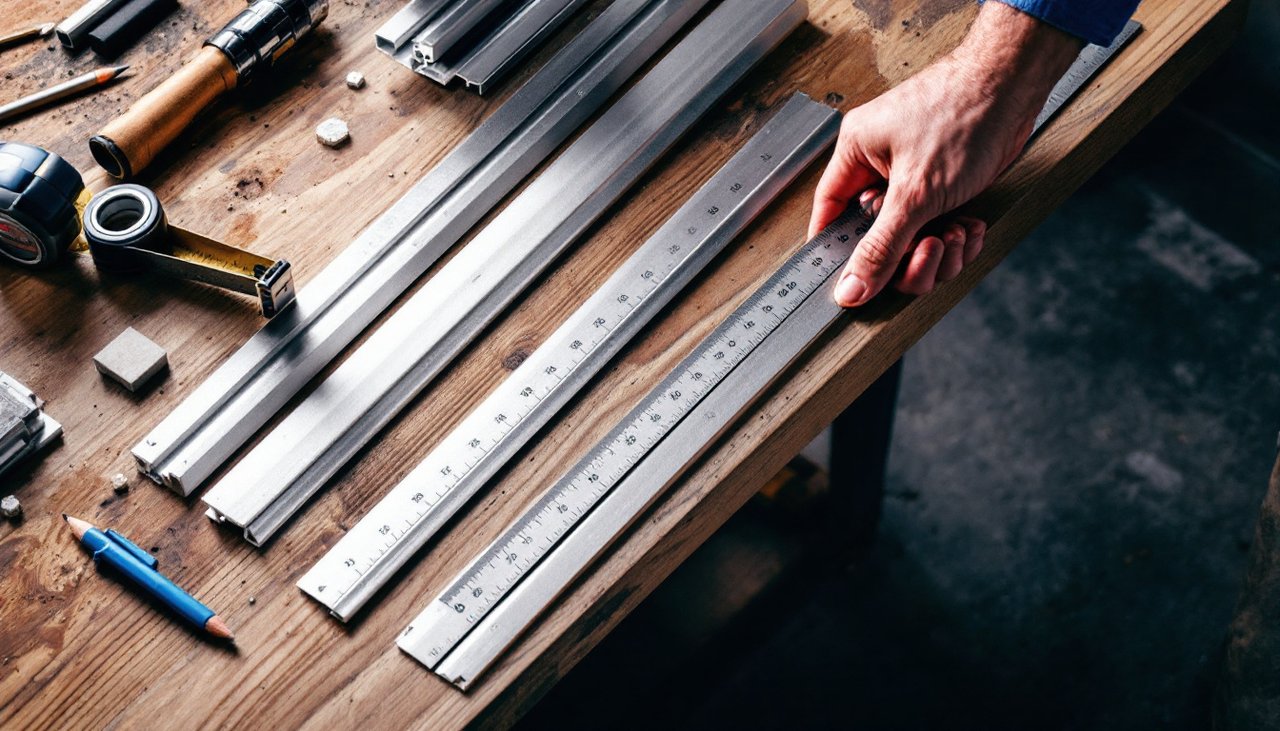
| Profile and length | 900 mm treads: lengths needed | 900 mm treads: cost | 1,100 mm treads: lengths needed | 1,100 mm treads: cost |
|---|---|---|---|---|
| Metal Mate, 1.0 m at $22.80 | 13 (one piece each) | $296.40 | Not suitable (a 1.0 m length cannot cover a 1,100 mm tread in one piece) | Not applicable |
| Rapid, 2.0 m at $42.73 | 7 (two pieces each) | $299.11 | 13 (one piece each) | $555.49 |
| Roberts, 3.3 m at $49.83 | 5 (three pieces each) | $249.15 | 7 (two pieces each, three leaves no cutting allowance) | $348.81 |
| Slip Proof, 3.0 m at $96.00 | 5 (three pieces each) | $480.00 | 7 (two pieces each) | $672.00 |
These figures cover the 13 tread edges only. The top landing piece usually comes from a spare offcut, except on the Metal Mate, which needs a 14th length ($319.20), and the Rapid on 1,100 mm treads ($598.22).
Two things jump out. First, the cheapest profile per metre stays the cheapest per staircase here, but the gap moves a lot once the tread width changes. Second, the 1.0 m profile that looked mid range drops out completely on a wider stair, because a 1.0 m length simply cannot cover a 1,100 mm tread in one piece, and a joint on the tread edge is not an option. Measure every tread before you price anything, because stairs in older homes are rarely identical from top to bottom.
- Budget by pieces per length, not by total lineal metres.
- Tread width can rule a profile out or double its cost on the same stair.
- Measure each tread separately, since older stairs vary.
The Full Stair Budget, Line by Line
The nosing is one line among several. A realistic quote for a carpeted stair being converted to a hard floor usually breaks down like the table below. We have not put rates against labour and preparation, because those depend on the stair you have, and any online rate that ignores your stair is a guess.
| Budget line | What it covers | How it is usually priced | What to check on the quote |
|---|---|---|---|
| Nosing profiles | One piece per tread edge, plus the top landing | Per length | Profile name, finish and the floor thickness it suits |
| Tread and riser covering | Laminate, engineered timber or a matching tread product | Per square metre or per tread | Whether risers are covered, painted or left as they are |
| Adhesive and fixings | Construction adhesive, screws or clips for the profile | Per pack or included | That the fixing method follows the profile instructions |
| Removing the old finish | Carpet, underlay, gripper strips and staples | Per stair or included | Disposal, and who removes the gripper |
| Tread preparation | Squaring rounded bullnose edges, packing, filling and securing loose treads | Per step or provisional sum | A clear description of what triggers extra cost |
| Installation labour | Cutting, scribing and fixing each tread and nosing | Per step | Whether the price covers open sides or winders |
| Top landing transition | Where the upstairs floor meets the first stair edge | Per item | That it matches the main floor detail |
The tread covering itself is usually a modest line. Thirteen treads at 900 mm wide and around 250 mm deep add up to roughly 3 square metres. Power Dekor's own laminate flooring cost guide recorded the Bunnings laminate range at $25.69 to $70.10 per square metre in July 2026, which puts the boards for those treads at roughly $75 to $205 at retail rates before cutting waste. Like the nosing, that is small next to the labour.
- Nosing and tread boards together are usually the smaller part of a stair budget.
- Removal, preparation and labour are where quotes differ most.
- A quote should name each line, not bundle the stair into one figure.
Labour: Why Stairs Are Priced Per Step
A flat floor is priced by area because most of the work scales with area. A stair does not work that way. Every tread is a separate set of cuts, a separate fit against the stringers, a separate nosing fixed to a separate edge. That is why installers price it per step rather than per square metre.
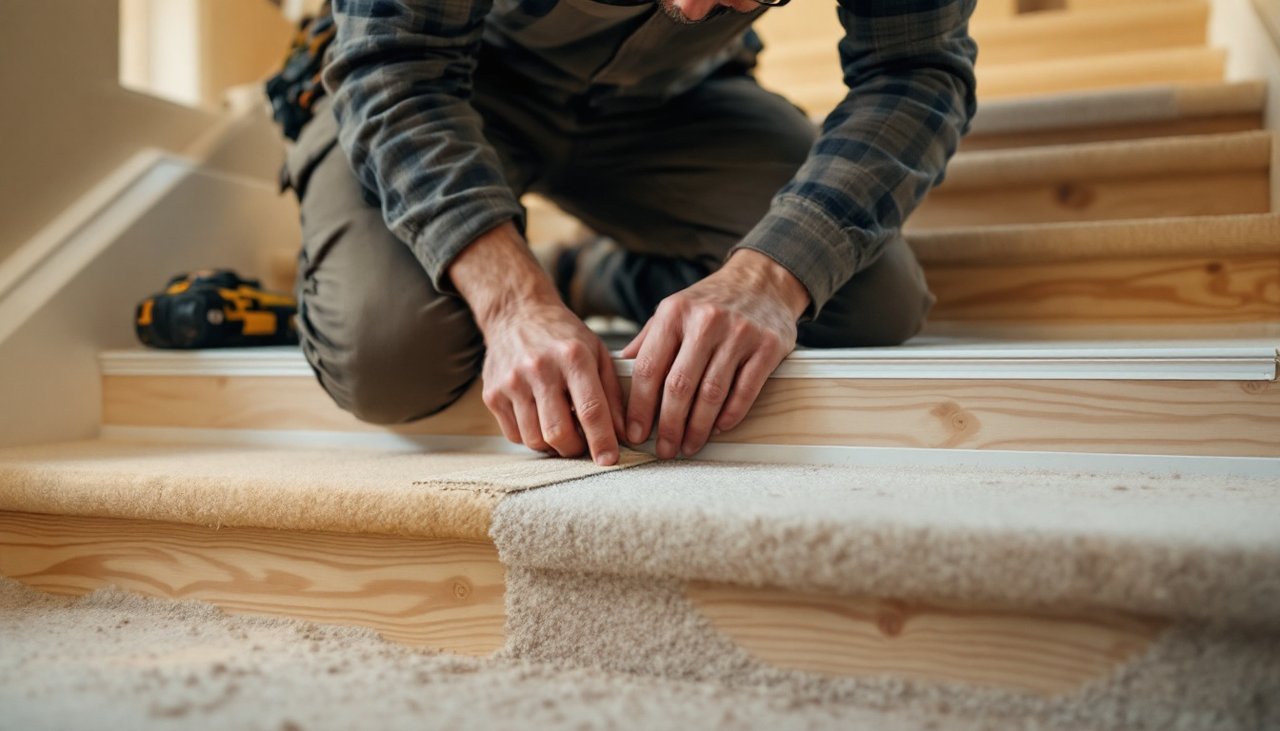
Several stair features push the per step price up:
- Bullnose treads that need squaring or packing before a profile will sit flat.
- Open sides, where the tread end is exposed and needs a return or a finished cap.
- Winders and quarter landings, where every piece is a different shape.
Preparation is the line most likely to change after the old carpet comes up. Carpet often hides damaged edges, old adhesive and loose treads. A careful installer prices a provisional allowance for it. A quote that assumes every tread is sound is not cheaper, it is unfinished.
- Stair labour is priced per step because each tread is its own job.
- A 13 step stair is 13 separate jobs, not 3 square metres of floor.
- Expect a preparation allowance, because carpet hides tread damage.
Fixing Methods and What Each One Adds
How the nosing is fixed changes both the materials list and the time spent on every step, and the profile you choose usually decides the method.
Screw fixed profiles are the simplest. Screws are cheap and the fixing is quick on timber and particleboard treads. Fixings may stay visible without a cover strip, and a concrete stair needs plugs and a hammer drill.
Glue down profiles rely on construction adhesive and leave no visible fixings, but the bond is only as good as the surface under it. A tread still carrying carpet adhesive or paint has to be cleaned back first, and that cost turns up on the preparation line.
Base track or clip systems fix a rail to the tread and clip the visible profile over it. They cost more per metre and take longer to set out, but a damaged edge can later be replaced without disturbing the tread covering.
- Screw fixing is cheap and fast but can leave visible fixings and is slower on concrete.
- Glue down looks clean but depends on a well prepared tread surface.
- Clip systems cost more upfront and make a single edge easier to replace.
Aluminium, Matching Profile or Solid Oak: Cost Over the Life of the Floor
The upfront price is only half the comparison. A stair edge takes concentrated wear, so the question is what happens when one edge wears or gets damaged in five or ten years.
| Nosing option | Upfront material cost | Look | When one edge wears or dents | Best fit |
|---|---|---|---|---|
| Retail aluminium profile | About $15 to $32 per metre at the retailers above | Visible metal edge, silver or black | Replace the single profile; standard sections are easy to source again | Rentals, back stairs, garage steps, tight budgets |
| Profile matched to a laminate range | Varies by range; quoted with the floor | Colour coordinated with the boards | Needs the same profile and decor; ranges change, so keep spares | Laminate stairs where the edge should blend in |
| Solid oak stair nosing | Quoted per project | Real timber edge that reads as part of the stair | Can usually be sanded and recoated rather than replaced | Engineered oak floors and feature stairs |
The cheapest profile on day one is not always the cheapest at year ten. Aluminium is easy to replace like for like. A matched laminate profile looks best but depends on the range staying available, so buying one or two spare lengths at the start is cheap insurance. Solid oak costs more at the start, but because it is timber all the way through, a worn edge can usually be refinished in place.
If you are laying an oak floor, the edge does not have to be metal. Tell us which floor and colour you have chosen when you send your stair measurements, and we will quote a matching solid timber nosing.
- Aluminium is the cheapest to buy and to replace like for like.
- Matched laminate profiles look cleanest; buy spare lengths up front.
- Solid oak costs more at the start but can usually be refinished, not replaced.
Wear Ratings: What Your Tread Covering Needs
Every step lands on the same strip at the front of each tread.
For laminate, check the AC abrasion class on the product specification. The classes run from AC1 for light domestic use to AC5 for heavy commercial traffic under the European standard EN 13329. On a main family stair, AC4 or above gives a margin that an AC3 board does not, and over roughly 3 square metres of treads, buying up a class barely moves the total.
For engineered timber, ask for the wear layer thickness in millimetres, not just the board thickness. A thicker oak top layer can be sanded back more than once, and a hard wearing finish slows the dulling that shows first on the tread edge.
- The tread edge is the hardest working strip of floor in the house.
- For laminate on a main stair, AC4 or above is a cheap upgrade over 3 square metres.
- For engineered timber, check the wear layer thickness and the finish.
Building Code Checks That Change the Budget
Changing the floor covering on a stair is not just cosmetic. Clause D1 Access Routes of the New Zealand Building Code sets the performance requirements for stairs, including slip resistance and even rises. Two things on a flooring job can affect that, and both cost money to fix after the fact.
The first is the top and bottom rise. When you add a new covering to every tread, the middle rises stay equal, but the floor thickness at the top landing and the bottom floor may not match the tread build up. That can leave the first or last step a different height to the rest, which is exactly where people trip.
The second is the edge itself. A smooth, polished nosing can be slippery in socks. Profiles with a grooved or anti slip insert cost more per metre, as the Slip Proof line in the first table shows, but they are worth considering on main stairs used by children or older family members.
- Check that the top and bottom rises still match after the new covering goes on.
- Plan the landing build up at the measure, not after installation.
- Anti slip inserts cost more per metre and suit busy family stairs.
Top Landings, Single Steps and Split Levels
Not every nosing is on a full staircase. Single internal steps, sunken lounges and split level homes all need an edge where a floor drops away.
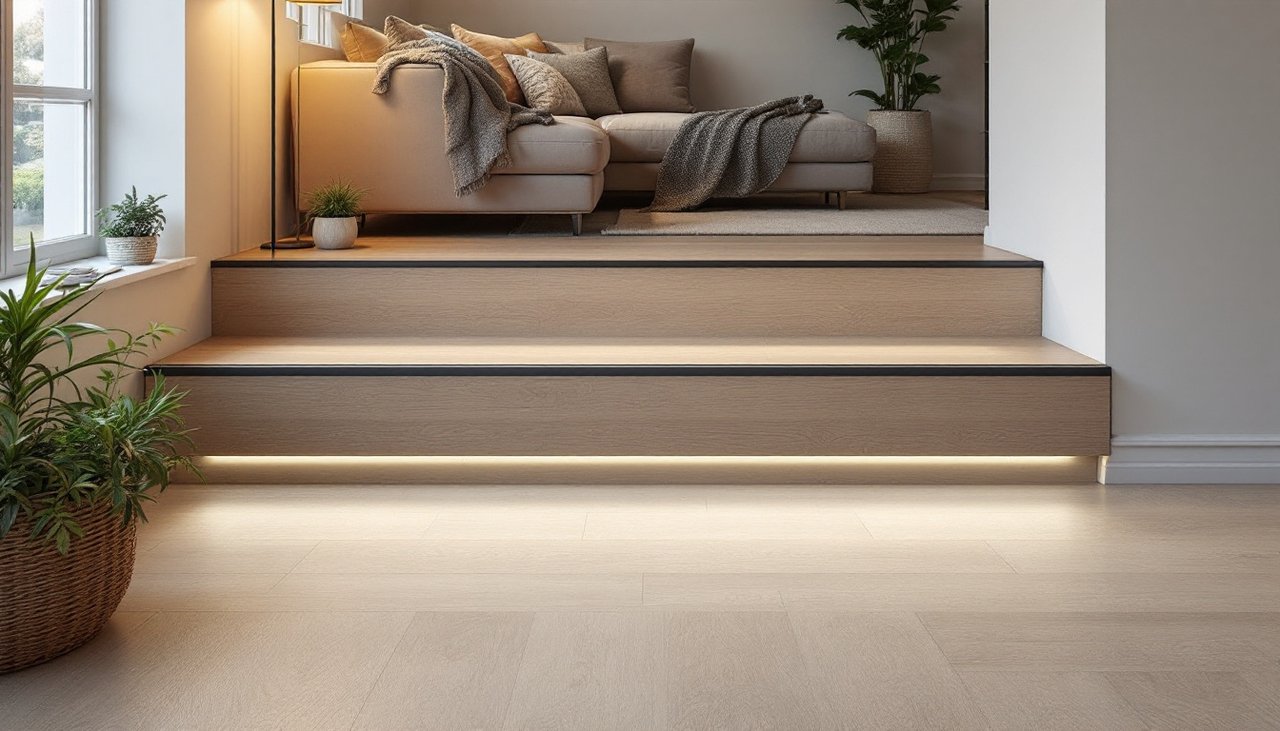
Price them the same way. Measure each exposed edge, note whether either end is open, and confirm the profile suits the floor thickness on the upper level. One step edge across a 3.6 metre lounge opening needs a long length or a carefully placed joint, and that changes which profile is cheapest. The top landing of a staircase works the same way.
- Single steps and split level edges need nosing and belong on the quote.
- Long open edges may need a longer profile length to avoid a joint.
- The top landing nosing is the most visible one, so match it to the main floor.
How to Get a Stair Quote You Can Compare
Quotes are only comparable if they price the same scope. Give every installer the same details:
- The number of treads, and the width of each one if they vary.
- Whether any tread ends are open, and whether there are winders or a quarter landing.
- The flooring product you want, its thickness, and the nosing look you prefer.
- Whether the risers will be covered, painted or left as they are.
- Who removes the old carpet and gripper, and who takes it away.
Then read the quotes against the budget table above. If one quote is much lower, check whether it leaves out preparation, the top landing or removal.
- Confirm whether each quote includes GST.
- Ask how long each price holds.
- Keep the leftover offcuts for future repairs.
We can do this part for you. Come to our Rosedale showroom on the North Shore to see timber and aluminium nosing options beside your chosen floor, or send us your stair measurements and photos and we will return an itemised list of the nosing, tread and fitting lines your stair needs. Prefer to talk it through? Call us on 09 444 8288, Monday to Friday 10:30am to 4pm and Saturday 11am to 4pm.
Stair Nosing Cost FAQ
How much does stair nosing cost in NZ?
Retail aluminium stair nosing at NZ retailers ranged from about $15 to $32 per metre when checked in October 2026. The real material cost depends on how many tread pieces you can cut from each length, so the 13 tread edges of a typical stair can land anywhere from about $250 to $670 in profiles alone, before any extra length for the top landing. Labour and preparation are priced separately and are often the larger part of the stair budget.
Why do installers charge per step for stairs?
Each tread needs its own cuts, fitting and nosing, so the work scales with the number of steps rather than the floor area. Bullnose treads, open sides and winders add time to each step and raise the rate.
Is solid oak stair nosing worth the extra cost?
It suits engineered oak floors and feature stairs where a timber edge matters. Because it is solid timber, a worn edge can usually be sanded and recoated instead of replaced, which helps over the life of the floor.
Can I use any nosing with laminate flooring?
No. A nosing profile is designed for a particular floor thickness and fixing method, so check that it suits your laminate before you buy. A profile that does not fit leaves a lip or an unsupported edge, which is a trip risk.